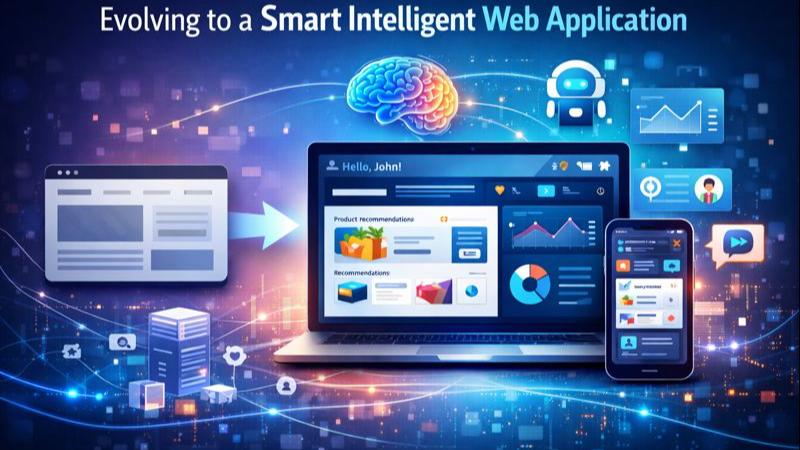
Web-based systems have become essential tools for managing information, delivering services, automating business processes, and supporting organizational decision-making. Traditionally, these systems have primarily relied on predefined rules, database operations, and user inputs to perform specific tasks. However, the rapid advancement of Artificial Intelligence (AI) is transforming traditional web applications into intelligent systems capable of learning, predicting, understanding, and adapting to user needs.
Integrating AI models into web-based applications introduces a new generation of smart systems that go beyond conventional data processing. These systems can analyze historical information, understand natural language, recognize patterns, generate recommendations, and automate complex activities.
This article explores the role of AI models in developing smart web-based systems, their major applications, integration approaches, and the opportunities they create for modern software development.
A smart web-based system is an application that integrates Artificial Intelligence techniques to improve its ability to process information, understand users, make predictions, provide recommendations, and support decision-making.
Unlike traditional systems, which mainly execute predefined instructions, AI-powered systems can use data-driven models to identify patterns and produce intelligent outputs.
For example, a traditional student management system stores student information, records attendance, and generates academic reports. An AI-powered student management system can additionally predict students at risk of academic failure, identify attendance patterns, and recommend appropriate academic support.
Similarly, a traditional municipal management system receives citizen complaints and forwards them to responsible departments. An intelligent municipal system can automatically classify complaints, identify urgent cases, prioritize service requests, and provide citizens with an AI-powered virtual assistant.
AI & Machine Learning
The Role of AI Models in Building Smart Web-Based Systems